

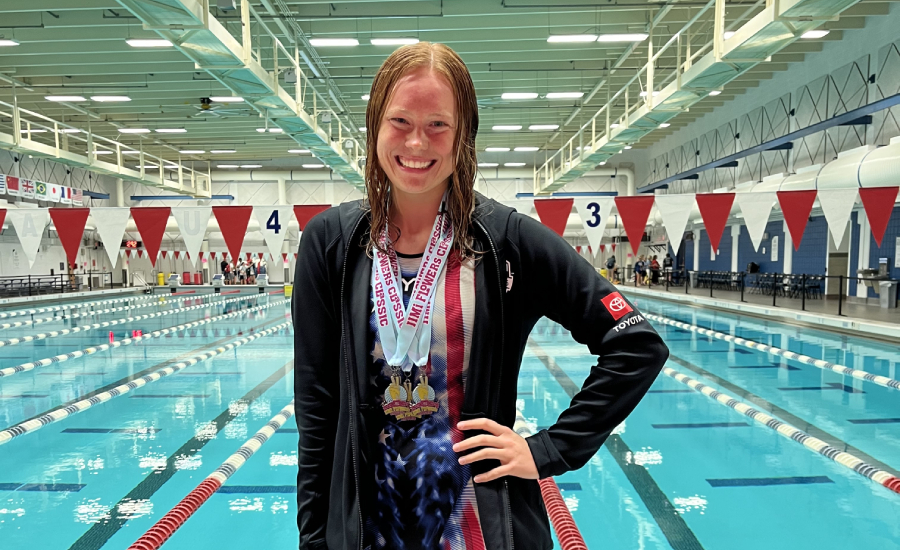
1. Your journey from a devastating series of accidents to becoming a para-swimmer on the U.S. Paralympics 2023 National Team is truly inspiring. Can you share more about the pivotal moment when you first heard about Paralympic Swimming and how that changed the trajectory of your life?
I owe Coach Brian Loeffler from Loyola University Maryland many thanks because he is the reason I learned that the Paralympics existed! I love sharing my story about parasports because I was an athlete for 13 years before I acquired my disability and I did not even know that the Paralympics existed! I initially committed to swim at Loyola during my senior year of high school, but after my injuries, I had to decommit. I thought my athletic journey was over forever. One day while swimming at the pool on campus, Brian walked up to me and told me about the Paralympics, and after watching me swim and knowing that I have a spinal injury I could be eligible. The trajectory of my life has changed drastically since then. I still remember how I felt after my pain management doctor told me that I would never be able to compete in swimming again. Since starting my para swimming career in May of 2019 I have competed in America, Italy, and Mexico, I have earned a bronze medal at nationals, and I have broken an American record in the Women’s S10 50 meter Backstroke. All by the grace of God!
2. The emotional and physical challenges you faced during your recovery and rehabilitation are remarkable. Could you delve into the role that swimming played in aiding your healing process, both physically and emotionally, especially considering the comfort and freedom you find in the water?
Something that I love about being in the water is that I do not need to worry about wearing leg braces, walking, using mobility aids, etc. The water is truly a freeing place to be! After I broke my back I struggled immensely with pain and I was afraid to be active. My mental health was at a breaking point as well. I spent my days doing online school while sitting on my parent’s couch. The only physical activity I had was physical therapy. My rehabilitationist encouraged me to try swimming again. I was afraid at first. Over time I was able to put my frustrations with my physical limitations, pain, and sadness back into the pool. Now I am almost 7 years out from my injury and swimming is still therapeutic for me physically and mentally. When I am upset over things I cannot control I love to train. I love the rush of pushing my body and finding new limits. It can be difficult, however, because training often does make my pain worse, but I overall feel better after I train. That is a tradeoff I am willing to make!
3. Advocacy seems to hold a significant place in your heart. How do you envision using your platform as a para-athlete to challenge society’s perceptions of disabilities and promote awareness and acceptance? Can you share any personal experiences that have strengthened your resolve to create change?
Before I acquired my disability I knew nothing about the disabled community. I did not think that I could become disabled, but the truth is that the only kind of minority that anyone can join at any time is the disabled community. A pivotal moment in my life was when I was in college. My roommate and I were walking somewhere during my freshman year when we began to talk to a guy. My roommate casually brought up that I was a swimmer. The man looked me up and down and apprehensively said, “Well, she doesn’t look like one.” I remember burning with embarrassment and thinking, “Did he say that because of my cane and disability?” That moment helped me realize that I wanted to help change the societal narrative of what being disabled looks like. Disabled people can be athletes, CEOs, parents, spouses, actors, etc., our possibilities are limitless, as long as we have accessibility and inclusivity. I hope my platform can show society that I love my life as a professional athlete who is disabled, married, and Christian.
4. Your dedication to the sport and your aspirations to compete on the global stage are commendable. With your eyes set on the Paris Paralympic Team for the 2024 Paralympic Games, could you elaborate on the goals you have for the near and distant future of your athletic journey? What drives you to continue striving for excellence?
Something that helps me focus on striving for excellence is remembering that my value as a person is not dependent on my ability to perform. If I get first or last in a race I am still a morally worthy person. I also like to set short-term and long-term goals to help me measure my progress. Some short-term goals I have for the rest of this season are: break 5:00 in 400 Freestyle, win a gold medal at Para Pan Am Games, and obtain the MET (minimum entry time) for the Paris Paralympic Games in 200 I.M. Some long-term goals I have for this year and next year are: break the S10 200 meter Backstroke American Record, obtain a national A team cut, and final at the Paris Paralympic Games.
6. The Zoom meeting you hosted for the young para-swimmer (Keila de Oliviera) from Namibia must have been a significant moment for her journey. Could you share some insights into the conversation and what messages or advice you conveyed to inspire her as she embarks on her para-swimming career?
Something I loved about being able to meet Keila de Oliviera was seeing her supportive family. Her uncle taught her how to swim, similar to how my mom taught me how to swim at a young age. It also warmed my heart to hear and see Keila’s mother and grandmother support her during her journey of being an athlete. Some advice I relayed to her family was to keep up the great support. It means everything to race and look up in the stands and see people who love and support you unconditionally. I also hope that Keila remembers her dreams on her hard days, because as an athlete hard days will come. Some days I am tired, or I am in pain, or I just do not feel like swimming. It is on my hard days when I still get up and go put in the work that makes my good days good. I hope Keila also knows that her disability is something that makes her: her. Being disabled has opened many doors for me. It has helped me be more empathetic. It has helped me learn how to advocate for myself and others. It has helped me meet amazing people around the world just like Keila!
7. Having overcome your own challenges and now connecting with a promising young para-swimmer, what words of encouragement and wisdom do you have for her as she navigates the path ahead, both in her athletic pursuits and personal growth?
Some words of encouragement I have for Keila, and any promising young para swimmer, is that you can use your gift to change the world, and there are many ways to do that. You can use the experience you will gain from being an athlete to learn how to be a great teammate, how to advocate for others, how to overcome societal expectations, how to show yourself what hard work looks like, how to use a special gift you have received, etc. Having the blessings that come with being a professional athlete has great power, and you can use your platform for good. Words of wisdom I have for any swimmer are to take care of your body, learn to love training, lift up your teammates, challenge yourself, “high-five” after every race, and give it your all. In regards to personal growth, it is important to remember that “being a swimmer” is not all of your identity. A day will come when you need to stop swimming, whether that is a physical injury, retirement on your own terms, etc. You need to consider what you want to do when you become a “swammer.” I hope to swim in some capacity for my entire life, but when I am done professional swimming I am considering many different avenues. One I for sure plan to do is to be a stay-at-home mom. I also am thinking about writing a book, supporting moms as a doula, and starting a nonprofit.
8. Motivating and mentoring a young athlete can have a lasting impact. Can you elaborate on your plans or ideas to continue supporting and guiding the Namibian para-swimmer in her journey? How do you envision being a source of motivation for her moving forward?
I hope that Keila’s family and her swim coach Diego know that I can be a person they can always talk to. I remember what it felt like being new to the para swimming world. There are many things to learn regarding qualifying for international events, being classified, learning the exception codes, etc. I also am just an athlete, so for any new coach or athlete I recommend getting in touch with World Para Swimming for guidance on their journey. I envision being a good role model for the next generation. I hope that other athletes can say that I am a “good sport” and that I treat people with respect, but I also hope that people can say that I hold others accountable, especially regarding the rules we have in place to keep para swimming safe and fair.
9. The experience of being a role model and source of inspiration is unique. How do you plan to leverage your platform and story to not only motivate the young para-swimmer but also to promote a broader sense of inclusivity and empowerment within the para-sports community?
I plan to continue my advocacy work on Instagram for as long as the Lord wills. I try my best to be open and honest by answering people’s direct messages and emails. I also have considered revamping my old Youtube account to “spread the word” about Paralympic sports. I hope that people see my page as an open area to discuss the many things I am passionate about a few of those are: adoption, disability rights, women in sports, etc.
10. Zoom meetings like the one you held can be transformative for aspiring athletes. Could you share any specific moments or exchanges from the meeting that stood out to you, and how they reinforced your commitment to fostering a supportive and motivating environment for young para-athletes?
Something that stood out to me was Coach Diego’s eagerness and excitement concerning Keila’s future in swimming. Coaches are one of the backbones of the majority of amazing athletes. Their desire for their athlete to be the best they can be is an admirable quality to possess. Coaches spend hours on the pool deck just like their athletes, but oftentimes coaches do not receive the credit they deserve. It encouraged me to see an aspiring athlete with an amazing family and coach as her support system. I also was honored to see Keila’s excitement in meeting me. I truly am just an ordinary girl who loves to swim, but to see a newer athlete who wanted a career like mine was a privilege!

We offer certified professional coaches who actively teach and coach. We use our own skill progressions for water safety skills and stroke development.
© 2025. Infinity Aquatic Centre. All Rights Reserved. Creative Designs